Earlier this week, I appeared as a witness at the Joint Committee on Artificial Intelligence. My contribution mainly focussed on a new working paper I published with my colleague Teresa Bonserio, which quantifies the potential energy and emissions impacts of new data centre energy demand that may be facilitated by the CRU Large Energy User Connection Policy. The video and debate can be found here, and the working paper is here.
A presentation with graphics of the key results from the paper is here.
Here are a few reflections following the very interesting session.
More renewables doesn’t necessarily mean benign for the climate
There’s a very deeply held belief among many that if data centres finance renewables project, then they automatically support climate action. If there was one message I wanted politicians to take away from this session, it was to dispel this intellectual fault. The illogic reasoning, to me at least, is very simple. The sustainable energy transition is about getting off fossil fuels - growing renewables is one of the most important ways to do this. But the LEU Connection Policy facilitates a big expansion in fossil fuel use, despite also requiring new renewables covering 80% of their demand. The policy requires data centres to construct on-site generation capacity (or battery storage) matching their demand, and the renewables requirement doesn’t kick in until six years following the date the data centre starts operating, and doesn’t cover all the data centre’s demand. My working paper demonstrates that this could imply strong growth in gas demand in the power sector, offsetting all the decline due to climate policies.
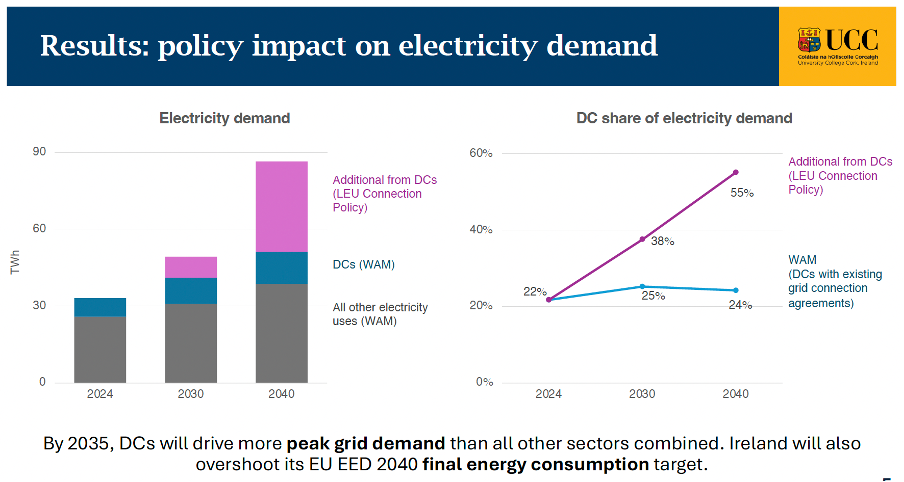
The paper actually shows that the renewables share of power generation declines because of the policy, because total demand (the denominator) grows much faster than renewables.
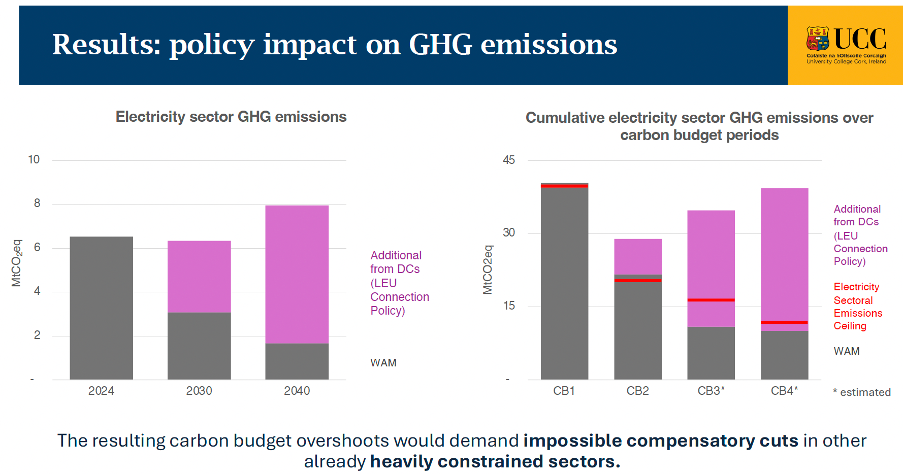
I’ve repeated it many times - renewables are not a stand-alone policy target - they only serve our energy transition if they displace fossil fuels. This policy would lead to a lot more gas use, and a lot more emissions, pushing multiple legally-binding climate targets even further out of reach. My impression was that this message didn’t fully get through to all politicians on the committee, and that we will continue to hear in public debate this persistent misunderstanding that data centres support sustainable energy even when they’re building large fossil fuel power stations.
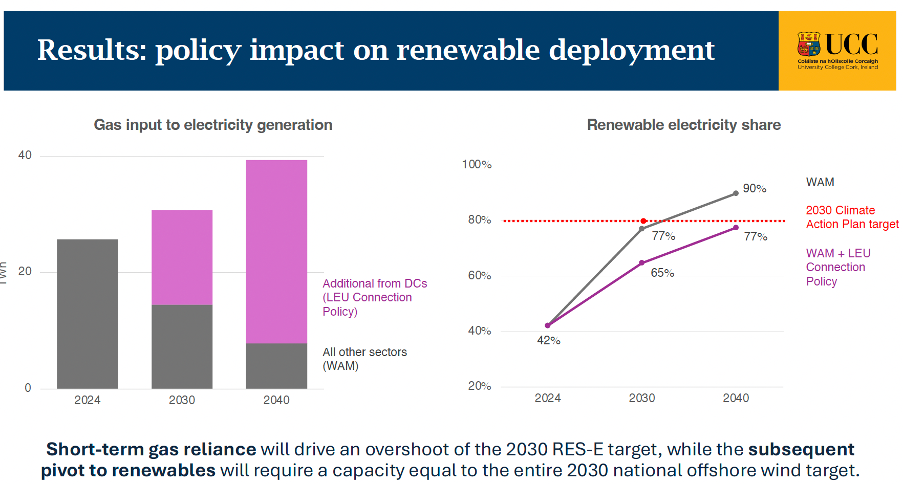
The enormous scale of the impact
I’m not sure I managed to convey just how large the impacts are, and the scale of how they conflict with climate and energy commitments. Data centres would account for 55% of all Ireland’s electricity demand, and use more fossil gas electricity generation than the electricity system is currently using. 5.8 GW is an enormous amount of new demand, and I don’t know why more alarm bells are not ringing. I invite you to look at the graphical overview of results from our working paper here to get a sense of the impacts, here.
AI good or bad? It doesn’t really matter
I tried to not get sucked into the “is AI good or bad” debate (though I do this it’s a very important one, and I am sceptical of the hype, particualrly the narrative that facilitating data centre growth is essential for Ireland’s economy). Let’s take the argument at face value and accept (for a moment) that facilitating massive data centre expansion in Ireland will bring a lot of wealth and employment. Does that justify such an expansion in fossil fuels that our working paper demonstrates is possible? Does that mean carbon budgets not legally binding after all, or that some sectors can get a carve-out because they are so essential to the economy? In my view, that mentality severely undermines the shared mission that is climate action.
Yes, I use “digital infrastructure”. I write this blog on a laptop, host it on my website, and I even ask ChatGPT to check it for errors, but just because these tools have value, it doesn’t give carte blanche for the sector to grow with such large dependency on fossil fuels.
I debated this question with Deputy Malcolm Byrne, who implied that because universities store data on the cloud, then there is no alternative to large-scale data centre growth. I have to be blunt - I think this reasoning is shallow and faulty. It would be akin to debating whether we should construct motorways between every village, or facilitate private jet transport for everyone, on the basis that I drive to work and so transport infrastructure is a necessity.
Solutions
I would have liked to have spent more time in the committee talking about regulatory solutions. Under what conditions could Ireland facilitate an expansion of data centres without undermining the energy transition? I referenced four requirements in my contribution.
- First, that data centres match 100% of their demand with renewables from the start, not after a six-year “glide path” where they can run entirely on fossil fuels.
- Second, these renewables would have to genuinely be additional - they would not have otherwise been built. Otherwise, this capacity would be diverted away from replacing fossil fuels
- Third, data centre demand would have to match the generation from those renewables during all hours of the year, not just on average across the year. Otherwise, a project could claim that solar power during a sunny summer month would offset the gas use in a dark winter month, which is impossible. That would require data centres to invest in a diverse portfolio of wind and solar, and different forms of energy storage, and also incentivise flexible operation so that workloads would be reduced when renewables output is reduced.
- Finally, the physical network infrastructure would need to be in place so that the data centre can actually consume the renewables output. Otherwise, it would need to fall back on thermal/fossil fuel generation when the grid is constrained.
None of those conditions is impossible to meet. It would mean the costs, risks and complexity of renewables integration would fall on large energy users, rather than on the rest of the system.
Currently, data centres are claiming sustainability for weak, or unsubstantiated, efforts. For example, Pure Data Centre in Dublin runs entirely on its own natural gas power plant, contributing to Ireland’s emissions and fossil fuel imports. But it claims to be fully decarbonised and in alignment with Ireland’s Climate Action Plan because it has bought certificates for biomethane generation in Germany (and has not, as reported by some in the media, actually imported biomethane to Ireland). This is not a credible pathway for decarbonising natural gas. It is a form of “Renewable Guarantees of Origin” which are widely recognised to be a weak form of offsetting, and in any case they don’t align at all with Ireland’s climate law. Even if the biomethane credit was purchased in Ireland, any biomethane produced here is needed to replace existing gas use for it to be of any use in supporting the energy transition. And this biomethane is not even produced or imported to Ireland. This example illustrates that an action can seem like meaningful decarbonisation but not in fact be in any way aligned with national climate objectives.
Impact on prices
One final point on the impact that data centres have on electricity prices, a topic that has generated a lot of debate. My own research doesn’t cover this, but my colleague Dr. Paul Deane posts about what drives electricity bills regularly on LinkedIn. On one hand, data centres could bring down the transmission infrastructure cost for everyone, by causing higher utilisation of electricity infrastructure (the same cost spread over many customers). On the other hand, there are multiple ways data centres could be creating upwards pressure on prices: They could also be driving up the need for the huge state investment in grid infrastructure that is coming down the line, as the main driver of electricity demand. Moreover, they are very likely pushing up the cost of generating electricity itself. The wholesale electricity price is the main component of our electricity bills, and this is driven mainly by the fossil gas price and the extent to which gas sets the marginal price in Ireland. It logically follows that if data centres are driving additional gas demand (especially of the scale indicated above), it will place upwards pressure on the wholesale price, and therefore costs. Consideration would also need to be given to the cost of energy security, such as Temporary Energy Generation in the winters of 2021-23 and the cost of shoring up gas import infrastructure (the State LNG terminal is estimated to cost around €1 billion). And finally there is the financial cost of missing various climate targets that may arise to the state. Various sides have claimed that data centres have a large, or benign, effect on bills, but I have seen no holistic, rigorous, transparent, independent analysis of the question. When Ireland’s high electricity prices are causing such hardship, that is a really large missing piece of research and really should be undertaken in the public interest.